Whether you're hauling heavy equipment to the jobsite, transporting a vehicle, moving building materials, or taking your ATV to the trails, properly securing your load is one of the most important steps before hitting the road.
An improperly secured load can shift during transport, damage your cargo, reduce trailer stability, or become a serious hazard for other motorists. Spending just a few extra minutes securing your cargo correctly can prevent expensive repairs, DOT violations, and potentially life-threatening accidents.
At Load'em Up Trailers, we've seen firsthand the damage that can occur when loads aren't properly secured. Follow these proven load securement practices to tow with confidence every time.
Why Proper Load Securement Matters
Even a small amount of load movement can create major problems while towing.
A shifting load can:
• Change your trailer's balance and tongue weight
• Increase trailer sway
• Damage your trailer or cargo
• Reduce braking performance
• Cause tire wear and suspension damage
• Lead to accidents or rollovers
• Result in DOT citations and costly fines
Proper load securement protects your investment—and everyone sharing the road with you.
Step 1: Choose the Right Tie-Down Equipment
Not every load should be secured the same way. Choosing the proper tie-down equipment is the first step toward safe hauling.
Ratchet Straps
Ideal for:
• ATVs and UTVs
• Lawn equipment
• Building materials
• Appliances
• General cargo
Chains and Load Binders
Best suited for:
• Tractors
• Skid steers
• Excavators
• Construction equipment
• Heavy machinery
Wheel Straps
Recommended for:
• Cars
• Pickup trucks
• Side-by-sides
• Race cars
Always verify that every strap, chain, and anchor point has a Working Load Limit (WLL) that meets or exceeds your cargo's requirements.
Step 2: Inspect Your Securement Equipment
Before every trip, inspect all of your tie-down equipment. Check for:
• Cuts, fraying, or burns on ratchet straps
• Bent or cracked hooks
• Stretched or damaged chain links
• Damaged D-rings or anchor points
• Loose trailer hardware
• Cracked or deteriorated trailer decking
If any component shows signs of wear or damage, replace it before towing.
Step 3: Position the Load Correctly
Proper weight distribution is just as important as the straps holding your cargo down.
For most bumper-pull trailers:
• Maintain approximately 10–15% tongue weight
• Center heavier items between the trailer axles
• Keep the load low whenever possible
• Avoid placing excessive weight behind the trailer axles
A properly balanced trailer provides better steering, braking, and towing stability while greatly reducing trailer sway.
Step 4: Use Enough Tie-Downs
One of the most common mistakes is simply using too few straps.
The official FMCSA Cargo Securement Rules can be found here:
https://www.fmcsa.dot.gov/regulations/cargo-securement/cargo-securement-rules?utm_source=chatgpt.com
General guidelines include:
• Loads under 5 feet long and under 1,100 pounds: Minimum one tie-down
• Loads over 5 feet long or over 1,100 pounds: Minimum two tie-downs
• Heavy equipment: Typically four independent securement points, plus separate securement for attachments
Remember, these are minimum standards. Additional securement provides additional safety.
Step 5: Cross-Strap Whenever Possible
Cross-strapping significantly reduces side-to-side movement.
Instead of running straps straight forward and backward:
• Attach the left front of the load to the right side of the trailer
• Attach the right front to the left side
• Repeat the same pattern at the rear
This creates an "X" pattern that helps resist movement during hard braking, acceleration, and cornering.
Step 6: Secure Every Moving Component
Don't overlook attachments or accessories that can shift independently. If it can move, it should be secured. Always secure:
• Loader buckets
• Backhoes
• Hydraulic attachments
• Forks
• Ramps
• Toolboxes
• Spare tires
• Fuel cans
Step 7: Protect Your Tie-Downs
Sharp edges can quickly cut through straps and significantly reduce their strength. Whenever a strap contacts a sharp edge, use proper protection.
Protect your investment by using:
• Edge protectors
• Corner guards
• Protective sleeves
• Rubber padding where appropriate
Step 8: Tighten Tie-Downs Correctly
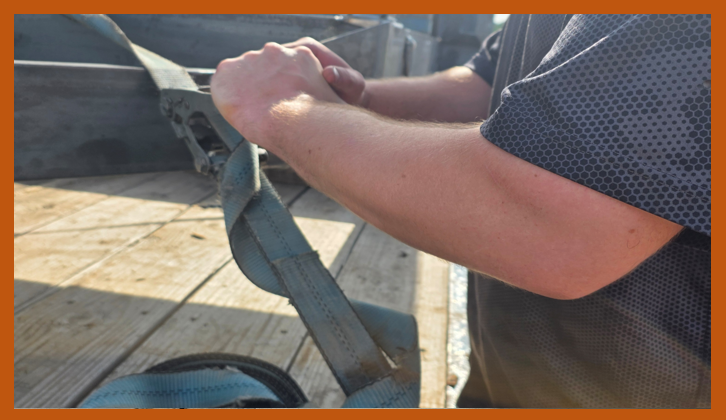
Your ratchet straps should be:
• Tight enough to prevent movement
• Evenly tensioned
• Free from twists
• Positioned so the ratchet won't loosen during travel
Avoid over-tightening, which can damage both the cargo and the tie-down equipment.
Step 9: Perform a Final Walk-Around
Before pulling onto the road, complete one final inspection. This inspection takes less than two minutes and can prevent major problems.
Verify that:
• Hitch coupler is fully latched and pinned
• Safety chains are crossed and connected
• Breakaway cable is attached correctly
• Trailer lights are working
• Tires are properly inflated
• Ramps are locked in place
• Every strap and chain is tight
• Cargo cannot shift
Step 10: Recheck Your Load After the First Few Miles
Even properly secured cargo can settle during transport.
After driving approximately 5–10 miles:
• Pull over in a safe location
• Inspect every strap and chain
• Retighten as necessary
• Confirm nothing has shifted
For longer trips, inspect your load at every fuel stop or rest break.
Common Load Securement Mistakes
Using Worn-Out Straps-Frayed or damaged straps should never be used.
Hooking to Weak Anchor Points-Only secure cargo to manufacturer-approved tie-down points.
Forgetting Attachments-Buckets, ramps, implements, and accessories should always be secured separately.
Improper Weight Distribution-Too little tongue weight is one of the leading causes of trailer sway.
Assuming "It's Good Enough"-Every load should be secured as though you'll need to make an emergency stop.
Recommended Securement Methods
ATV or UTV
• Four ratchet straps
• One at each corner
• Slight suspension compression
Car Trailer
• Four wheel straps or axle straps
• Secondary safety strap or chain recommended
Skid Steer
• Four Grade 70 transport chains with binders
• Secure the bucket separately.
Lumber and Building Materials
• Multiple ratchet straps across the load
• Use edge protectors when necessary
• Install a red warning flag if cargo extends beyond the trailer.
Don't risk your cargo—or your safety. Secure every load, every trip. Safe towing starts before your trailer ever leaves the driveway.